What We Learned in Lublin: The First LAB and TOUR of V4 Improv Connect 2.0
From 9–13 September 2026, performers from Slovakia, Czechia, Hungary and Poland came together in Lublin for the first LAB and TOUR of V4 Improv Connect 2.0: Stories Without Borders.
Hosted by our Polish partner, Eastern Theatre / Teatr Wschodni, the Lublin programme combined two intensive creative LAB days, an outreach workshop, international artistic exchange and the first public performance of our developing format.
It was an important beginning: a chance to bring the international ensemble together for the first time, test our artistic ideas in practice and discover what Stories Without Borders needs in order to grow.
Learning with Arkadiusz “Arek” Ziętek
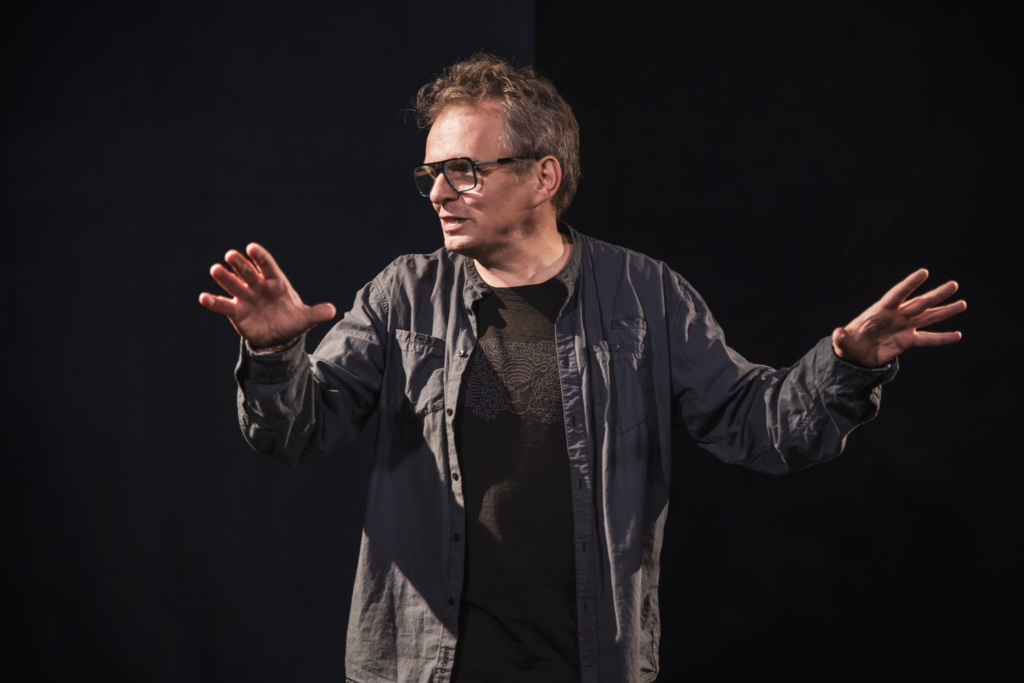
The Lublin LAB was led by Arkadiusz “Arek” Ziętek, a Lublin-born actor, director, theatre educator and one of the artists who helped introduce modern improvisational theatre to Poland.
In 2007, Arek co-led one of Poland’s early improv workshops with Mike Hughes of the Canadian company Uncalled For. His artistic development was also strongly influenced by studying and working with Keith Johnstone, one of the most important figures in modern improvisational theatre.
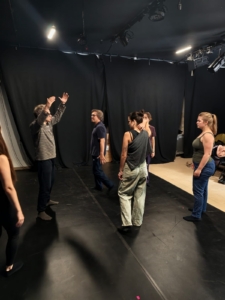
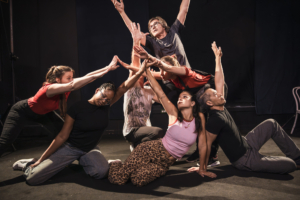
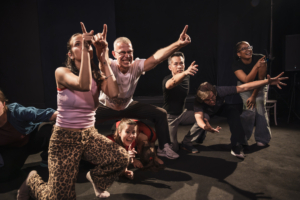
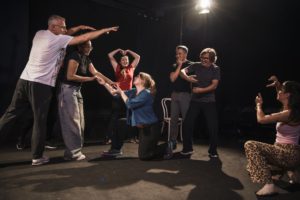
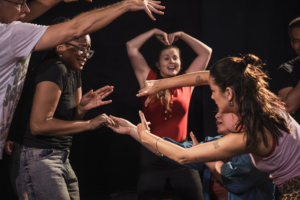
During two full LAB days on 10 and 11 September, Arek worked with the eight-person V4 ensemble on spontaneity, storytelling, character, stage communication and the principles that shaped Johnstone’s approach to improvisation.
Arek also joined us for a recorded interview in which he shared stories from his experiences with Keith Johnstone in Canada and reflected on how those encounters influenced his understanding of improvisation, acting and creative risk.
These conversations gave the group valuable insight into the history behind many of the techniques improvisers now use around the world. They also reminded us that improv is not simply a collection of comedy games. At its strongest, it is an approach to acting, storytelling, listening and discovering what can emerge when performers are genuinely present with one another.

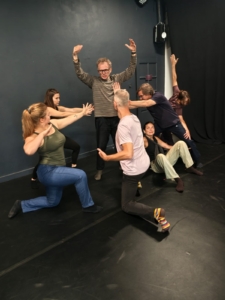
Four countries and one international ensemble
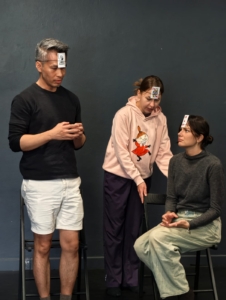
The Lublin LAB brought together eight performers representing the project’s four Visegrad partner theatres:
- Slovakia – ISAC / Funnylicious Theater: Hon Chong and Juraj Benčík
- Czechia – ČNID / Joke Division: Michal Beneš and Veronika Opatrná
- Poland – Eastern Theatre / Teatr Wschodni: Paulína Prokopiuk and Adriana Pulley
- Hungary – Itt és Most Társulat: Veronika Bán-Horváth and Luca Pelsőczy
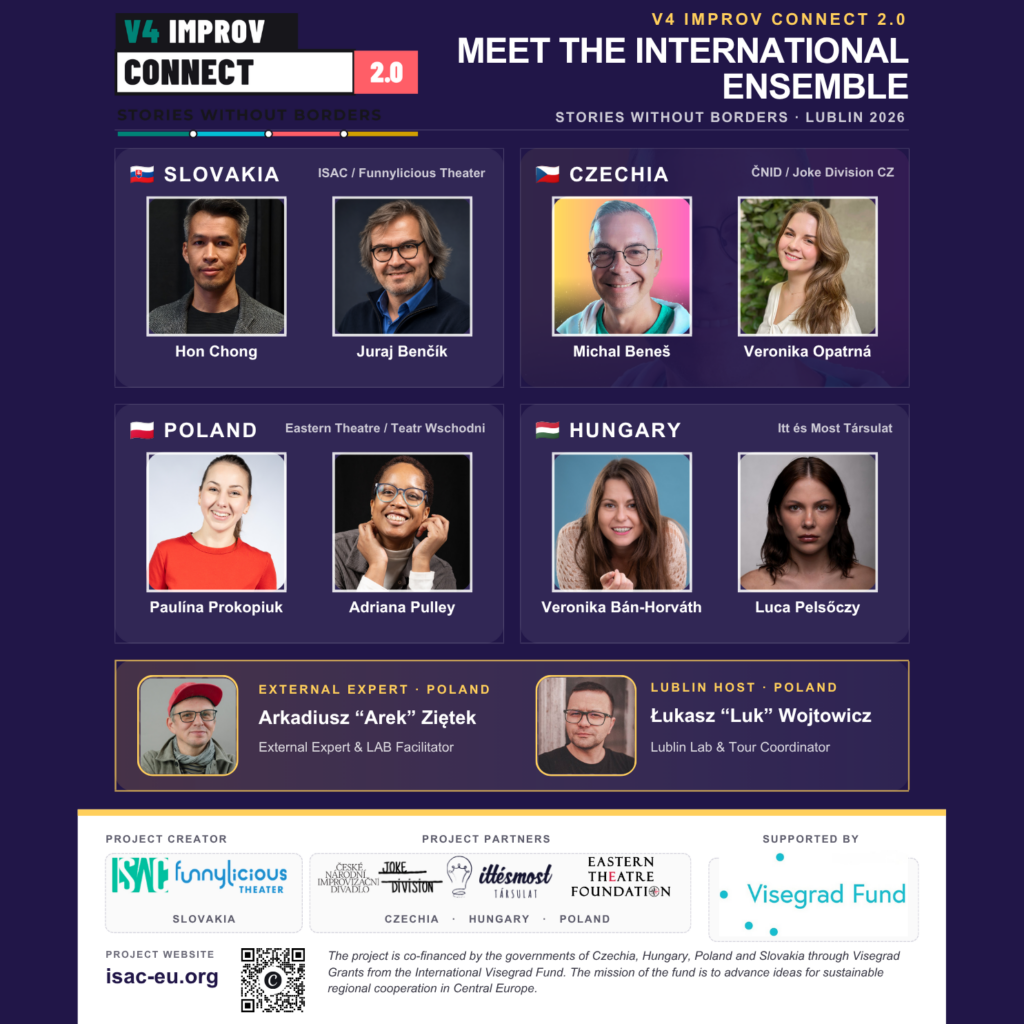
The performers brought very different experiences into the room: short- and long-form improvisation, acting, directing, applied theatre, screen performance, education, storytelling, movement and physical theatre.
This diversity is essential to the project. Stories Without Borders is not meant to belong to one national tradition or one particular school of improv. It is being created through the exchange of methods, artistic perspectives and cultural experiences from all four Visegrad countries.
For the Slovak team, Juraj Benčík was invited specifically for his expertise in mime, movement and non-verbal performance. Juraj began his improv journey with Funnylicious Theater, but his wider professional career extends across drama, directing, puppetry and physical theatre. He also performed for two years with Cirque du Soleil, including its production Corteo.
This physical and non-verbal experience was particularly valuable to a project exploring how performers can communicate when spoken language cannot carry the whole story.
The developing performance was also supported by Polish musician Łukasz Rzepecki, who joined the ensemble to explore how live music could contribute to atmosphere, rhythm, emotional shifts and storytelling.
Creating inside an international theatre festival
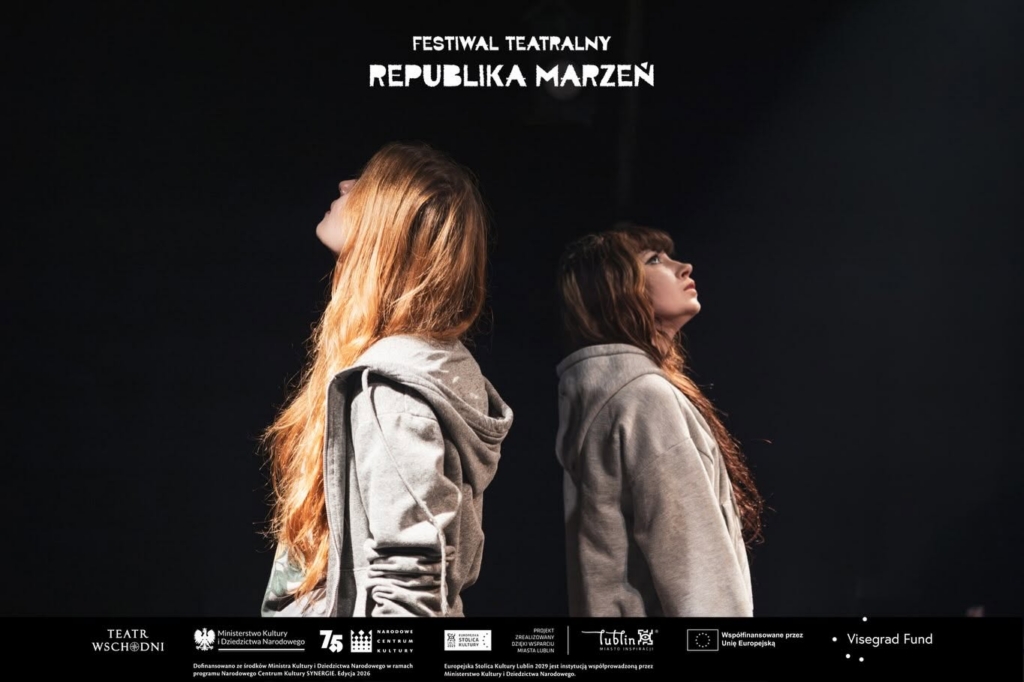
The Lublin LAB and TOUR formed part of Dreams Republic Festival 2026, organised by Eastern Theatre.
Being surrounded by theatre makers and artists from different parts of the world made the Lublin experience much richer. The festival programme brought together performances, workshops, discussions, music and artistic projects from several international contexts.
This placed our work inside a wider theatre environment rather than isolating it as a separate improv event. It allowed the V4 ensemble to encounter other performance traditions and reminded us that physical storytelling, music, movement and visual communication have long helped theatre cross linguistic and cultural boundaries.
It also created opportunities for informal conversations, shared meals and new professional connections between artists who might otherwise never have met.

An outreach workshop that brought festival artists together
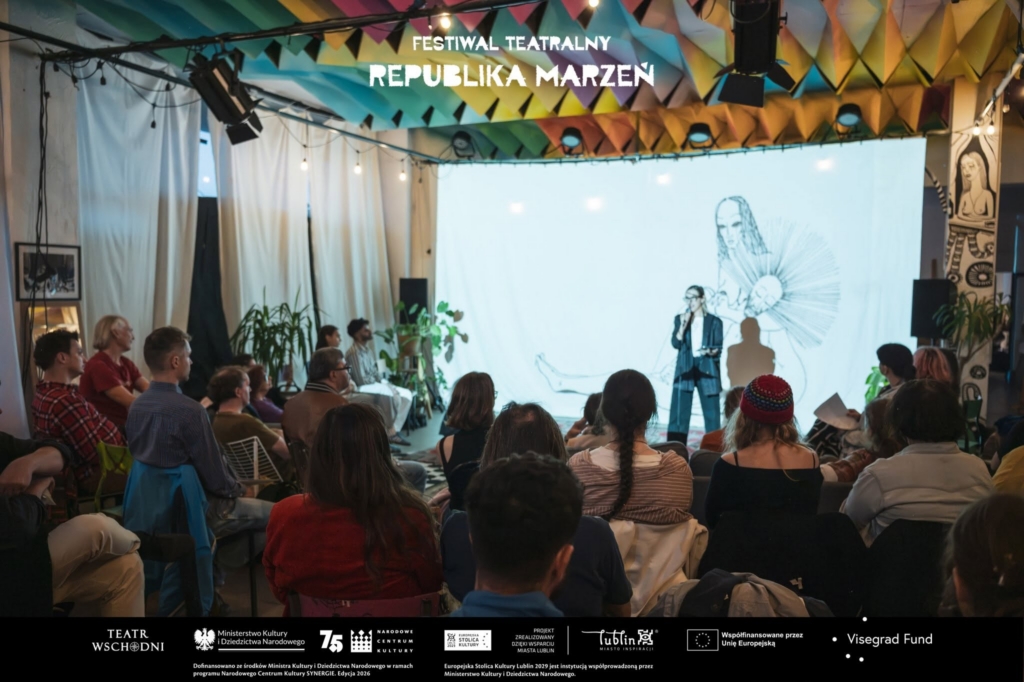
On Saturday morning, project creator and artistic lead Hon Chong facilitated an improv theatre workshop at Teatr Wschodni for artists participating in the international festival.
The workshop used improvisation as a shared meeting point between people with different theatrical practices, languages and cultural backgrounds.
Through practical exercises, play and collaborative storytelling, participants were able to connect quickly, take creative risks together and experience one another as collaborators rather than simply as artists appearing on the same festival programme.
The workshop helped strengthen connections between festival participants and created a greater sense of belonging within the festival community. It also demonstrated the value of improvisation outside a conventional improv performance: as a tool for communication, inclusion, trust and exchange between international artists.

The first public performance of Stories Without Borders
On the evening of Saturday, 12 September, the ensemble presented the first public version of Stories Without Borders at Akademia Sztuki Nowoczesnej.
The performance was offered free of charge, helping remove financial barriers and making the event accessible to a broader local audience. Łukasz “Luk” Wojtowicz and Eastern Theatre also invited participants from the international festival to join the audience.
The venue reached full capacity, with more than 80 people attending the performance.
For a new and experimental format receiving its first public test, this was an encouraging response. The audience included local theatre and improv audiences, festival participants and artists from different cultural backgrounds.
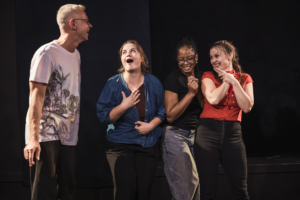
The performance brought the international cast, live music and material explored during the LAB onto the stage for the first time. It allowed the team to experience how the ensemble worked together under real performance conditions and how an audience responded to the developing concept.
Just as importantly, it gave us something concrete to examine, discuss and improve.

What did Lublin achieve?
The Lublin edition fulfilled several important objectives of V4 Improv Connect 2.0.
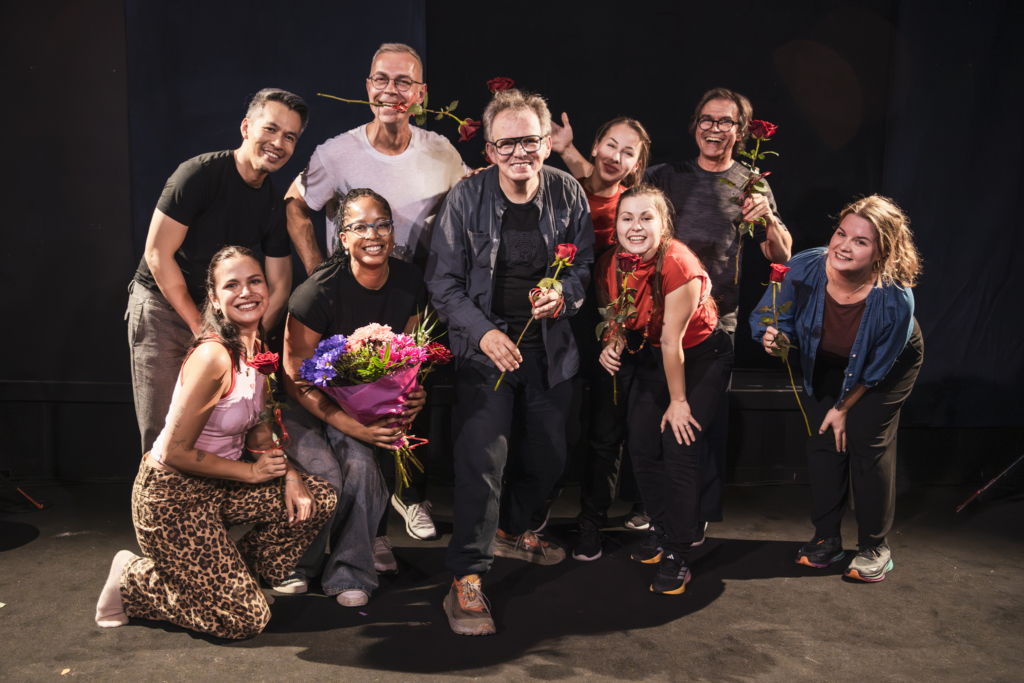
It brought together eight core performers from all four Visegrad countries for sustained artistic collaboration. The participants trained with an external expert, exchanged methods and began building trust as an international ensemble.
It connected improvisational theatre with a wider international theatre festival and introduced the project to a full-capacity public audience in a professional cultural setting.
The outreach workshop extended the project beyond the core ensemble, using improv to connect artists from different countries and performance disciplines.
The programme also produced the first public prototype of Stories Without Borders. This gave the partners a practical starting point and revealed both the strengths of the ensemble and the areas that require further artistic development.
Perhaps most importantly, Lublin transformed an idea written in a project application into a real shared experience. The team travelled, trained, created, performed and reflected together. That process gave us knowledge that could never have been gained through planning alone.
What did we learn?
A creative LAB should not only confirm what already works. It should reveal what still needs to be solved.
The Lublin performance relied more heavily on familiar short-form improv structures than we had originally intended. This created an energetic and accessible first show, but it also showed us that we had not yet explored the central artistic question of the project deeply enough:
Can we create an improvised theatrical story that audiences can follow and enjoy without depending primarily on a shared spoken language?
Lublin showed us that achieving this requires more than placing performers from different countries on the same stage. It requires focused experimentation with non-verbal communication, physical storytelling, movement, music, character relationships, emotion and clear narrative structure.
We also learned that the LAB must function as a genuine creative laboratory—not simply as a general workshop or a rehearsal for a conventional improv show. The public performance should grow directly from the ideas and methods tested during the LAB.
The experience highlighted several practical lessons as well:
- External experts need a precise artistic brief before the LAB begins.
- Performers must be selected for their interest in and suitability for this particular artistic challenge.
- Core participants need to attend the full LAB and rehearsal programme.
- Artistic roles and responsibilities must be clear while keeping the creative process collaborative.
- Venue, technical, travel, catering, promotion and documentation arrangements should be settled earlier so the team can concentrate on the artistic work.
Following the Lublin debrief, the partners reaffirmed their commitment to the experimental direction of Stories Without Borders. The team also agreed on the importance of clear overall artistic responsibility, with Hon Chong carrying the format’s final artistic direction while continuing to invite ideas, experimentation and constructive disagreement from the ensemble, partners and external experts.
Carrying the learning forward
Lublin was never expected to produce the finished version of Stories Without Borders.
It was the first real test. Its success lies not only in the full audience, international participation or completed performance, but also in the clarity it gave us about what must happen next.
For the Budapest LAB, the team will focus more directly on multilingual and non-verbal storytelling, physical performance, music, character and narrative. The next external expert will receive a clearer artistic brief, and the public performance will be used to test what the ensemble discovers during the LAB.
This is how the project is intended to work: each city contributes something, each performance reveals something and each lesson travels forward.
The first version of Stories Without Borders was created in Lublin. The next version will not simply repeat it. It will build on everything Lublin taught us.
The partners behind the Lublin edition
The Lublin programme was coordinated locally by Eastern Theatre / Teatr Wschodni, led by Łukasz “Luk” Wojtowicz, with support from Paulína Prokopiuk and the local team. The Polish partner connected the project with Dreams Republic Festival, coordinated the local venues and programme, supported accommodation and meals, invited festival participants and local audiences, and contributed to promotion and practical delivery.
ISAC / Funnylicious Theater led the international project coordination and artistic direction, supported programme development, participant communication, travel and accommodation coordination, marketing, documentation and overall compliance with the project objectives.
ČNID / Joke Division and Itt és Most Társulat selected and sent their participating performers, contributed their artistic knowledge and perspectives, and supported the project’s international visibility and dissemination.
Every performer contributed to the LAB, rehearsal and public performance and will carry the experience back into their own theatre community.
We are grateful to Arek Ziętek, Łukasz Rzepecki, the Eastern Theatre team, Dreams Republic Festival, the participating artists and everyone who joined us for the first performance.
Next stop: Budapest
V4 Improv Connect 2.0 continues in Budapest, Hungary, with the next creative LAB on 30 October and the next public performance of Stories Without Borders on 31 October 2026. Lublin gave us the beginning. Budapest will take the experiment further.
About V4 Improv Connect 2.0
V4 Improv Connect 2.0: Stories Without Borders runs from 2 March 2026 to 31 May 2027 and connects improvisational theatre communities in Slovakia, Czechia, Hungary and Poland through creative LABs, artist exchange, touring performances, external expert training and community outreach.
The project is created and led by Hon Chong / International Society for Arts and Culture (ISAC)/ Funnylicious Theater, in partnership with:
ČNID / Joke Division — Czechia
Itt és Most Társulat — Hungary
Eastern Theatre / Teatr Wschodni — Poland
ISAC / Funnylicious Theater — Slovakia
Media enquiries
Hon Chong
Project Creator & Artistic Lead
V4 Improv Connect 2.0
ISAC – International Society for Arts and Culture / Funnylicious Theater
Email: hello@isac-eu.org
Tel.: +421 918 895 948
Supported by the International Visegrad Fund

The project is co-financed by the Governments of Czechia, Hungary, Poland and Slovakia through Visegrad Grants from the International Visegrad Fund. The mission of the fund is to advance ideas for sustainable regional cooperation in Central Europe.